 (+57) 3235897210
 hey@crezgo.com


Surprising fact: in cryptocurrency privacy work, a single design decision — whether the wallet ever leaves your private view key on a server — can determine whether your entire transaction history is linkable. That’s not a hypothetical: it’s the practical boundary between plausible deniability and systemic exposure. This article uses a specific practical case — a US-based privacy-conscious user who wants to hold Haven (XHV), Monero (XMR), and Bitcoin (BTC) in one secure, private environment — to explain how modern multi-currency privacy wallets work, where they help, where they do not, and what trade-offs the user must accept.
The choice is consequential. Privacy coins like Monero and Haven use fundamentally different mechanisms than Bitcoin to obscure sender, receiver, and amount. A wallet that aggregates these capabilities without leaking metadata is more than a convenience: it is an engineering integration challenge. I’ll walk through the mechanisms, compare trade-offs for XMR vs. XHV vs. BTC, and show how to evaluate a wallet’s privacy guarantees using practical heuristics you can reuse.
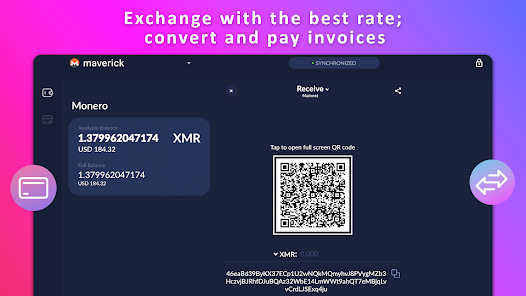
Case setup: a US user who needs XMR, XHV and BTC in one place
Imagine Sarah, a US resident who wants to: 1) receive XMR donations privately; 2) keep a strategic small BTC position without exposing on-chain linkage; and 3) try Haven Protocol (XHV) because of its asset-pegged features. Her constraints: legal awareness (she wants to avoid regulatory or tax surprises), usability (mobile-first), and strong network anonymity. She prefers non-custodial control: if keys are compromised outside her device, funds should still be recoverable only by her seed.
Mechanically, Sarah’s priorities map to three wallet features: device-level encryption and local key custody, network-level anonymity (Tor/I2P and custom node access), and native support for XMR/XHV primitives (subaddresses, view keys, shielded flows). A practical wallet integrating these is a stronger candidate than cobbling multiple single-coin clients together — but integration brings its own caveats.
How the mechanisms work (and where they diverge)
Monero obscures linkages primarily with ring signatures (mixing decoys), stealth addresses (unique one-time addresses per receive), and confidential transactions (hiding amounts). Crucially, Monero uses a private view key that permits monitoring incoming transactions without exposing spending keys. A privacy-savvy wallet keeps that private view key local and never exports it — otherwise, server-side monitoring can trace receipts.
Haven Protocol (XHV) is a Monero fork that extends privacy by introducing «vaulted» assets and synthetic assets (e.g., xUSD) within the chain. It inherits Monero’s privacy primitives but layers additional contract-like behavior. That makes XHV compatible with Monero-style privacy but increases the attack surface: cross-asset conversions and wrapped-asset flows can re-introduce metadata unless the wallet handles them atomically and locally.
Bitcoin, by contrast, is transparent by default. Privacy tools for BTC therefore operate at the wallet and network layer: coin control, batching, PayJoin (P2EP/PayJoin v2), and Silent Payments reduce linkage, while on-network routing (Tor-only mode) hides IPs. Wallets that support both Monero-style native privacy and Bitcoin privacy must avoid cross-contaminating metadata. For example, if a wallet submits a BTC swap and logs the swap on a server, a network adversary could link the two chains by timing and identifier correlation.
What to look for in a privacy-first multi-currency wallet
Using the Sarah example, a practical checklist emerges. The wallet should be open-source and non-custodial so keys stay local; support device-level encryption such as Secure Enclave or TPM and require a local PIN or biometrics; and offer Tor/I2P or custom node connections for network anonymity. It should keep the Monero private view key on-device and enable subaddresses and background sync so receive addresses are unique and discoverable only locally. For Bitcoin, features like Silent Payments, PayJoin v2, and explicit UTXO coin control reduce on-chain linkability.
A wallet that meets these requirements while also supporting Haven (XHV) and Litecoin MWEB, hardware wallet integration, and in-app swaps through decentralized routing can be operationally convenient. But convenience has trade-offs: built-in exchange routes must not leak transaction details or rely on centralized custodians. Prefer systems that route swaps via decentralized intents (automation across market makers) and maintain zero-telemetry policies to avoid server-side logs.
Practically, Sarah could choose a wallet that integrates these pieces. For hands-on testing and a multi-platform footprint (iOS, Android, desktop), she might explore implementations such as cake wallet that advertise exactly these features — device-level encryption, Tor-only mode, Monero private view-key retention, PayJoin v2, LTC MWEB, hardware wallet support, and a strict zero-data-collection policy. That combination reduces multiple real-world attack vectors simultaneously.
Where such wallets still break: limits and boundary conditions
No wallet makes privacy absolute. Three important limits are worth underscoring. First, operational security (OpSec). If Sarah reuses addresses, links on public profiles, or transacts while logged into deanonymizing services, the best wallet cannot protect her. Second, cross-asset swaps create linkage risk if not performed atomically and via privacy-preserving paths — swap partner selection, timing, and on-chain change outputs can reveal patterns.
Third, platform-level leaks. Even with Secure Enclave or TPM protecting key material, mobile devices can leak metadata through OS telemetry, app stores, or compromised network stacks unless the user carefully manages permissions, updates, and app sources. The wallet’s Tor/I2P modes help, but they depend on correct configuration and the broader device environment.
There are also currency-specific caveats. Zcash migration quirks are a reminder: incompatible seed behavior between wallets can force manual transfers. And for Haven (XHV), its more complex asset model demands wallet support for internal conversions to avoid exposing behavior to an external exchange that might log identifiers.
Decision framework: three heuristics you can reuse
When evaluating any privacy wallet for mixed XMR/XHV/BTC use, apply these heuristics: 1) Key locality test — does the wallet keep private view and spend keys strictly on-device and allow seed-based recovery without server interaction? 2) Network isolation test — can you force connections through Tor/I2P or custom nodes, and is there an explicit Tor-only mode? 3) Swap opacity test — are in-app swaps routed via decentralized intents or centralized partners, and does the provider claim a zero-telemetry policy that you can verify in code?
These heuristics map directly to attack surfaces: key compromise, network correlation, and swap/transaction logging. They also point to evidence: look at open-source repos for code paths that export keys, inspect network configuration screens for proxy options, and examine how the wallet documents its swapping architecture (NEAR Intents, market makers, or central custody).
What to watch next (near-term signals and conditional scenarios)
There are two signals that will matter soon. First, wallet integration of hardware air-gapped signing (like Cupcake or Ledger support) will reduce remote compromise risk; adoption rates and usability improvements are worth monitoring. Second, improvements in decentralized swap routing (better NEAR Intents-style automation) can materially reduce metadata leaks during cross-chain operations — but only if swap routes eliminate centralized custody and avoid attaching auxiliary identifiers.
Conditional scenarios: if regulators push for on-chain traceability mandates, wallets may be forced to introduce optional reporting paths or optional server-side analytics; that would change the calculus for privacy-conscious users in the US. Conversely, if open-source wallets continue to harden device-level protections and standardize Tor/I2P-first defaults, the operational cost of private multi-currency holdings will fall, making privacy a practical choice for more users.
FAQ
Q: Can a single wallet truly keep Monero, Haven, and Bitcoin private at the same time?
A: Yes, but «truly» depends on configuration and behavior. A wallet that keeps Monero view keys local, uses Tor/I2P, supports PayJoin and coin control for BTC, and routes swaps through decentralized intents can materially reduce linkage across chains. It cannot, however, protect you from poor OpSec, device compromise outside the wallet, or forced disclosure in a legal process.
Q: Is mandatory shielding for Zcash relevant to Monero or Haven users?
A: It’s a useful comparison. Mandatory shielding prevents accidental transparency leaks in ZEC flows; the broader lesson is that wallet defaults matter. For Monero and Haven, similar safety comes from enforcing local-only key handling and subaddress use. Wallets that choose privacy-preserving defaults significantly reduce user error.
Q: If I enable Tor-only mode, do I still need a hardware wallet?
A: Yes, Tor protects network privacy, but hardware wallets protect key material from device compromise. They address different risk layers. Combining them — air-gapped signing with network anonymity — is the strongest practical posture for high-risk holdings.
Q: How should a US user think about legal risk?
A: Privacy tools are legal to own in many jurisdictions, but reporting obligations (taxes, suspicious activity reports) remain. Privacy-conscious users should consult legal and tax advisors; choose wallets that let them export standard transaction records for compliance if needed while still preserving on-chain privacy as much as technically possible.
Takeaway: for someone like Sarah in the US, a privacy-first, multi-currency wallet that combines device-level encryption, strict key locality, Tor/I2P support, careful BTC privacy tools, and privacy-aware swap routing is the pragmatic path toward resilient anonymity. None of these features guarantees perfect secrecy, but when assembled and configured correctly they change privacy from fragile aspiration into an operational posture you can manage. Watch defaults closely, prioritize non-custodial open-source code, and treat cross-asset swaps as the most sensitive operations — they are where linkage risk hides.